
Dolly Casino KYC: Verification, Documents and Withdrawal Checks
 Available in US
Dolly Casino can carry out KYC before or after deposits and withdrawals. Its current official Terms, version 1.12 last updated 19 August 2026, say the operator may request information used to manage an account, verify identity and age, confirm residence, examine the source of deposited funds, and verify ownership or transaction history for payment methods. The Terms currently identify ID, proof of residence and payment-method ownership or history as core evidence categories.
When Dolly makes a request, the Terms state that the requested documents and information must be provided within 30 days. After the request has been answered in full, Dolly says it will usually verify the material within 10 days, although additional time or checks can be required depending on the circumstances and complexity of the case. These are current Terms values, not a guarantee that every account will be cleared in the same period.
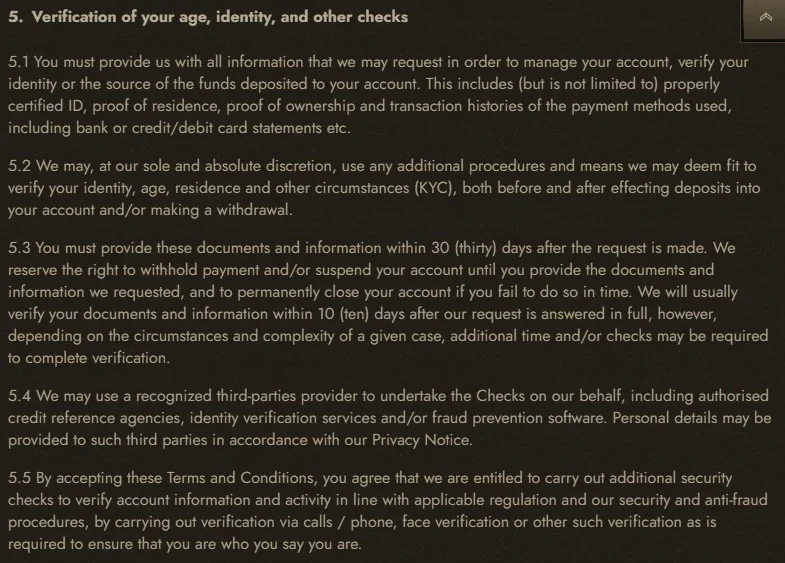
Table of Contents
- When Dolly can request KYC
- What document categories are currently verified in the Terms?
- The 30-day response window
- How long does Dolly say verification usually takes?
- How KYC affects withdrawals
- Payment ownership can be part of the review
- Source-of-funds checks
- Additional verification methods
- How to prepare without inventing a checklist
- KYC does not establish Australian licensing
- Bottom line
When Dolly can request KYC
The current Terms allow verification both before and after money moves through an account. Dolly states that it can use procedures it considers appropriate to verify identity, age, residence and other circumstances before or after deposits and withdrawals. That means KYC is not limited to a single fixed “first withdrawal” checkpoint.
A user can therefore encounter verification during account review, after depositing, when requesting a withdrawal, or when further security checks are triggered. The Terms also allow additional checks in connection with account information and activity, including calls, phone-based verification, face verification or other security procedures where required.
The practical implication is that registration details should be accurate from the start. The account registration guide explains Dolly’s rule that account information must be true, complete and kept current. A KYC review can compare later evidence with the identity and payment information already attached to the account.
What document categories are currently verified in the Terms?
The safest way to describe Dolly’s KYC requirements is by the categories the current Terms actually name. They include:
- Identity documentation used to verify who the account holder is.
- Proof of residence used to confirm the residence information associated with the account.
- Payment-method ownership and transaction history, including evidence connected with bank or credit/debit card activity where relevant.
- Source-of-funds information when Dolly requests evidence about the origin of money deposited to the account.
The Terms give examples in some clauses, but KYC requirements can vary by account and review type. A document accepted in one case is not automatically sufficient in another, so the operator’s current request is the most relevant instruction.
This is deliberately narrower than many casino verification guides. It avoids inventing requirements such as a mandatory selfie, a specific utility-bill age, a notarisation rule or a particular file format unless the current official request or Terms explicitly require it.
The 30-day response window
Dolly’s current Terms say requested documents and information must be supplied within 30 days after the request is made. The same clause allows the operator to withhold payment or suspend the account until the requested material is provided, and it gives Dolly the right to close the account permanently if the information is not supplied in time.
This 30-day figure is a customer response deadline. It is not the operator’s verification-processing target and should not be confused with the separate 10-day wording that begins after a request has been answered in full.
For a user, the useful action is to read the request carefully and answer through the operator’s official account or support channels. Sending only part of the requested material can leave the request incomplete, which means the later verification window may not yet have started on the Terms’ wording.
How long does Dolly say verification usually takes?
The live Terms currently state that documents and information are usually verified within 10 days after the operator’s request is answered in full. They immediately qualify that wording by saying additional time and/or checks can be required depending on the circumstances and complexity of the case.
That makes the 10-day figure a usual processing statement, not a guaranteed maximum. A straightforward identity check and a more complex source-of-funds investigation can follow different timelines. Extra security procedures can also extend the process.
It is important not to convert this into a promise such as “KYC takes 10 days”. The accurate reading is: after a complete response, Dolly usually verifies within 10 days, but some cases require more time or further checks.
How KYC affects withdrawals
KYC and payouts are directly connected in Dolly’s Terms. The company may delay a withdrawal to perform checks on identity, account balance, source of funds and compliance with the Terms. It can postpone payments until verification procedures and checks have been completed successfully.
The separate withdrawal guide explains Dolly’s current internal financial-processing window and AUD withdrawal limits. The key point here is that the stated withdrawal-processing window applies subject to completed checks. An account waiting for KYC should not expect the financial-processing figure to override an unresolved verification request.
Verification timing and withdrawal timing also should not be added together as a guaranteed total. The sequence can include document collection, KYC review, Dolly’s internal financial handling and then a separate payment-provider settlement stage. Different accounts can therefore produce different end-to-end cash-out times even when they are governed by the same Terms.
Payment ownership can be part of the review
Dolly’s Terms require the payment method used to fund an account to belong to the account holder. The KYC section also allows the operator to request proof of ownership and transaction histories for payment methods used. This creates a clear link between the identity on the account and the financial route used to deposit or withdraw.
Practical preparation means using your own account details and your own payment method from the beginning. It does not mean uploading unnecessary financial records pre-emptively. Wait for the current official request, then provide the categories of evidence Dolly asks for through the proper channel.
If the payment route changes between deposit and withdrawal, the cashier and operator instructions matter. Dolly’s Terms say the preferred withdrawal method cannot always be guaranteed, which is another reason a KYC request can focus on payment ownership rather than merely on a photo ID.
Source-of-funds checks
The current KYC wording specifically allows Dolly to request information about the source of funds deposited to an account. A source-of-funds check asks where the money used for gambling came from; it is not identical to ordinary identity verification.
The live Terms do not establish one fixed package of financial documents for every case. The relevant evidence depends on what the operator requests and the activity being reviewed.
Users should keep transaction records and respond with accurate information rather than trying to create a document set based on a generic internet checklist. If the request is unclear, use Dolly’s official support channel and ask what specific evidence is needed.
Additional verification methods
Dolly’s current Terms also allow additional security checks. They mention verification by calls or phone, face verification and other procedures used to verify account information and activity. These possibilities explain why a KYC review can extend beyond uploading documents.
The Terms do not say every user will undergo every method. Presenting face verification or a phone call as mandatory for all withdrawals would therefore overstate the current text. They are tools Dolly reserves the right to use when required by its security and anti-fraud procedures.
If an additional check is requested, verify that the instruction comes from the operator-controlled website or official support route before sharing sensitive information.
How to prepare without inventing a checklist
- Keep the name, residence and contact information on the account accurate and current.
- Use only payment methods that belong to you.
- Keep records of deposits, withdrawals and the payment routes used.
- Read the exact KYC request instead of assuming a standard set of files will always be sufficient.
- Respond within the current 30-day deadline if Dolly requests documents or information.
- Send sensitive information only through operator-controlled channels or official support instructions.
- Keep a copy of what you submitted and when, especially if the verification is connected to a withdrawal.
This approach is more reliable than pre-uploading a passport, bank statement or other personal material simply because another review says those items are commonly requested. The current Terms define categories, but the live case determines the exact request.
KYC does not establish Australian licensing
Identity checks and local licensing are separate subjects. The fact that Dolly performs KYC does not establish that it holds an Australian licence or that Australian licensed-wagering consumer-protection schemes apply to the casino. Those questions belong in the trust and Australian legal context guide.
This separation matters because KYC is an operator account-control process. It can exist regardless of whether a brand holds a licence in the user’s own jurisdiction. The verification page therefore focuses only on the current account and withdrawal checks documented in Dolly’s Terms.
Bottom line
Dolly Casino’s current Terms allow KYC before or after deposits and withdrawals and identify identity documentation, proof of residence, payment-method ownership or transaction history, and source-of-funds information as relevant verification categories. Users are currently given 30 days to provide requested information.
After a request is answered in full, Dolly says it will usually verify the material within 10 days, but additional time or checks can be required. Treat that as a current Terms statement rather than a guaranteed completion time. For the withdrawal stage that follows, use the dedicated payout guide and the current cashier rather than assuming KYC completion alone fixes the final payment date.
Prepared by the Dolly Casino editorial staff.